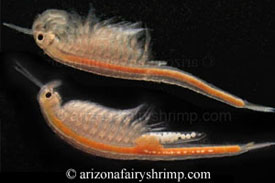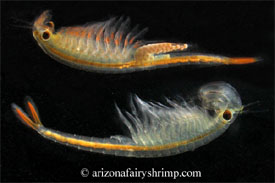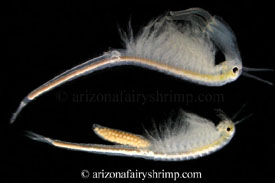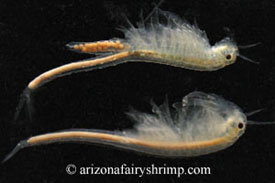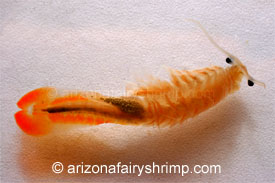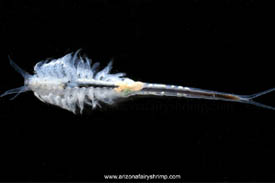
Fairy Shrimp
Clam Shrimp
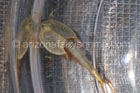
Triops
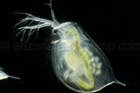
Water Flea

|
Fairy Shrimp (Anostraca)
Fairy shrimp is a kind of fresh water shrimp, they are also called as fresh water artemia. They live in non-salty water of temporary pools during the summer and the winter after its species. They swim ventral side up with 11 pairs of legs (22 total), and have two eyes, two sets of antennas. One set of antennas is on the head, another set is near the mouth. Male fairy shrimps have larger antennas than female shrimps, and some species use the antenna to grasp female shrimp in mating.
The color varies by the species: red, red-orange, orange, green, blue, partially black and white. Vernal pool fairy shrimps are usually red, green and white, while dry lake fairy shrimps are red-orange, partially black and white; other colors can be found rarely.
|
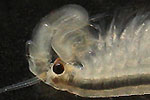
Streptocephalus is the most popular family found in Arizona. Usually, they live in vernal pools, the tail is red, and they grow up slower than other families. But one of the species live in dry lake grow up as fast as Branchinecta. Their size is between 3/4 inch to 1 1/2 inch. Live for about 3 to 4 months.
|
|
|
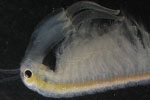
Branchinecta can be found in both dry lakes and vernal pools. Usually they hatch out during the winter season, and live until the water dries up. They grow up very fast and produce hundreds of eggs per female fairy shrimp in a short period. Their size is between 1/2 inch to 1 1/2 inch. They survive up to 3 months.
|
|
|
Thamnocephalus is a family name of beavertail fairy shrimps, and there are only two species. Beavertail fairy shrimp is the largest fairy shrimp in Arizona, and will provide the best look in your aquarium. They also grow up faster than any other species. Their size is between 1 to 2 inch, and survive for about 3 to 4 months in the best environment.
|
|
The families have been distinguished by the shape of the antennas of the male as shown above. Their sizes and life cycles vary after their species in the same family. We named the shrimps with new names as we've found them, which are not scientific or common names.
Click the below pictures to see the detailed information by species.
Click Here for Hatching and Raising Instruction
The following is the list of all fairy shrimps found in Arizona so far (based on Arizona Game and Fish data).
Scientific name
Branchinecta coloradensis
Branchinecta kaibabensis
Branchinecta lindahli
Branchinecta packardi
Eubranchipus bundyi
Eubranchipus serratus
Streptocephalus dorothae
Streptocephalus henridumontis
Streptocephalus mackini
Streptocephalus sealii
Streptocephalus texanus
Thamnocephalus mexicanus
Thamnocephalus platyurus
|
Common name
Colorado Fairy Shrimp
Kaibab Fairy Shrimp
Versitle Fairy Shrimp
Rock Pool Fairy Shrimp
Knobbedlip Fairy Shrimp
Ethologist Fairy Shrimp
New Mexico Fairy Shrimp
New Species
Chihuahuan Desert Fairy Shrimp
Spinytail Fairy Shrimp
Greater Plains Fairy Shrimp
Mexican Beavertail Fairy Shrimp
Beavertail Fairy Shrimp
|
|
|